2. Creating and Setting Up a Course
Where you start: My Courses (/courseware/courseslist) in Instructor mode.
⚠️ BodhiTree’s instructor interface does not work on a phone. Below 768 pixels wide the entire instructor application is replaced by a message asking you to use a larger screen. Author your course on a laptop or desktop.
2.1 The My Courses dashboard
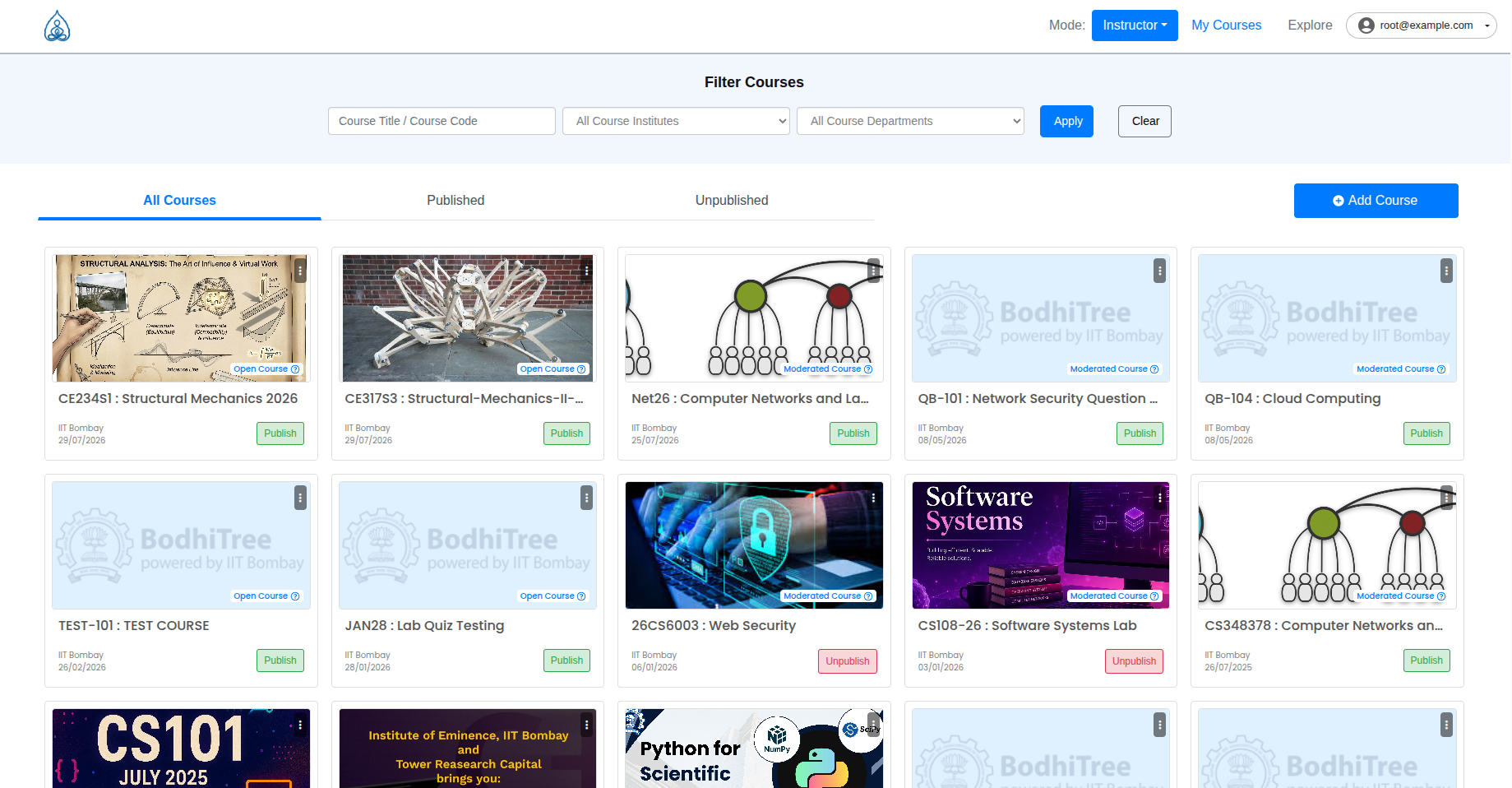
Filter your courses by Course Title / Course Code, Institute, and Department, then Apply (or Clear).
Three tabs sort your courses: All Courses, Published, Unpublished.
Each course card shows its image, an Open Course / Moderated Course badge, and carries a ⋮ menu with Download and Delete Course, plus a Publish / Unpublish button.
2.2 Creating a course
Click + Add Course.
Field |
Rules |
|---|---|
Course Image |
Optional, with a crop tool |
Course Code |
Maximum 8 characters, letters, numbers, spaces and hyphens only |
Course name |
Required |
Institute |
Pick from the list |
Department |
Pick from the list |
Enrollment Type |
Open or Moderated |
Course Content |
Create on own, Import using File, or Import using URL |
Discussion Forum Settings |
Two checkboxes, both on by default |
The course-code limit is strict; you will see “Up to 8 characters (alphanumeric, space and -) are allowed for course code.”
Choosing an enrollment type
Type |
What happens when a student clicks Enroll |
|---|---|
Open |
They are enrolled instantly |
Moderated |
They go into a pending queue and see nothing until you approve them |
Choose Moderated for any course where the roster matters. You can approve in bulk later (§3.4).
The two forum defaults
Both forum checkboxes are ticked by default:
Emails sent to all on every post: every forum post emails the entire class. For a large or busy course, consider turning this off before students arrive.
Reveal identity of “anonymous” posts to instructor: you can see who wrote anonymous posts. Students are told this in the posting form.
2.3 Importing a course
From a file
Choose Import using File and supply a .tar.gz archive. Anything else is
rejected with “File must be of type .tar.gz”.
The upload is chunked and resumable, which matters for large course archives:
A progress bar shows “Uploading: N%” with the warning “…do not close or reload this window!”
Closing the dialog mid-upload offers Keep uploading, Hide & keep uploading, or Abort course creation
If you reload the page the upload stops. On your return, a banner offers to resume, but you must re-select the same file. A different file is rejected with “This is not the same file. Please select the original archive you were importing.”
Once uploaded, the import runs in the background. While it does, you will see “Import will take time and is in progress in background.” and a cancel link.
From a URL
Choose Import using URL and paste an export link from another BodhiTree course. This is the counterpart to the Copy Link button in the download dialog (§2.5).
The course list refreshes itself when the import finishes. BodhiTree checks every ten seconds while an import is running; when it completes, the new course appears and the dialog closes on its own. You do not need to reload.
2.4 Publishing and unpublishing
New courses are unpublished. Students cannot find or enter them.
Unpublishing shows a warning worth reading:
Un-publishing a course option is intended to revert accidental/temporary publish of course or to hide old offerings.
Course after un-publish will not be visible in course list page, but can be accessed directly through url…
Unpublishing does not lock the course. It removes the course from listings only. Students who are already enrolled keep their access and can return through a saved URL, which is what that warning is about. Someone who was never enrolled cannot get in: opening the URL without an active enrollment is refused.
So unpublishing tidies your course list; it is not a way to withdraw a course from the students taking it.
2.5 Downloading, sharing, and exporting
⋮ → Download opens the Course Download dialog. Tick the content you want: one checkbox per chapter, plus Labs (ticked by default) and Other Labs (Legacy). Click Start Download.
The archive is built in the background. When it is ready you get:
⬇️ Download: the
.tar.gzfile🔗 Copy Link: a shareable link, with an Active/Inactive toggle
🗑️ Delete Export
Paste that link into another course’s Import using URL field to copy a course between BodhiTree instances or accounts.
What is not exported: lab timing fields. available from, available till, and
exam start/end times are deliberately excluded, so you must re-set all dates after
importing. See §5.7.
2.6 Deleting a course
⋮ → Delete Course, then confirm.
The option is hidden if the course has content protection on and you are not its creator (§2.7).
2.7 Course Settings
Where: sidebar → Course Management → Settings
Seven cards, each saved on its own. Saving one does not save the others, a common cause of “my change didn’t stick”.
The control differs from card to card: Update on Course Settings, Edit then Submit on About Course, and Save on Multimedia Book, Course Announcement, Discussion Forum and BodhiBot. Content Protection has no button at all — its switch takes effect as soon as you confirm the dialog.
Card 1: Course Settings
Shows “Course created by:
Title: this field is actually the course code (8 characters maximum), despite its label
Full Title: the course name
Enrollment Type: Open or Moderated
Institute, Department
Course Image: images only
Enable CodeVaani Voicebot
Enable BodhiBot Chatbot: and, once saved on, Log BodhiBot Chats for Instructor?
Card 2: About Course
The rich-text course description students read.
The same page is reachable from About Course in the sidebar, or directly at
/courseware/course/{courseId}/content/about.
Card 3: Multimedia Book Settings
Setting |
Effect |
|---|---|
Course Content as course home page for students |
Students land on the table of contents rather than the first item |
Reveal Answer Response as Right or Wrong |
Students learn whether each quiz answer was correct |
Reveal Correct Answer |
Students are shown the right answer |
Prefix for Course Content |
Word before the number in the contents list: |
The two reveal settings are the most consequential thing on this page. See Appendix A §A.3 for exactly what students see in each combination.
Card 4: Course Announcement Settings
Emails sent to all students on every announcement. This single checkbox is what decides whether announcements email the class; there is no per-announcement choice when you write one.
Card 5: Discussion Forum Settings
Emails sent to all students on every post and Reveal identity of anonymous posts to Instructor/TAs.
Card 6: Content Protection
This card is only visible to the course creator. Co-instructors and STAs cannot see or change it.
With content protection on (the default), only you, the creator, can delete course content: chapters, sections, and learning elements. Other instructors and TAs do not even see the delete options.
Turning it off warns:
Disabling content protection will allow Instructors and Senior Teaching Assistants to delete course content. Are you sure?
This is the single most important safety setting in a co-taught course. Leave it on unless you have a specific reason.
Card 7: BodhiBot Settings
AI chatbot configuration. Requires separately deployed AI services to function.
2.8 Additional Pages
Extra static pages: a syllabus, a policy page, an FAQ.
+ Add Page in the sidebar creates one: Title plus a rich-text body
Each page can be edited or deleted from its own view
Reorder with the ⇅ button: the list becomes drag-and-drop and the button changes to Save. Your order is not stored until you click Save
Known limitations
Unpublishing does not block direct URL access for already-enrolled students
Previous: 1. Getting Started · Next: 3. People and Enrollment